"Neither slavery nor involuntary servitude, except as a punishment for crime whereof the party shall have been duly convicted, shall exist within the United States, or any place subject to their jurisdiction."
The Thirteenth Amendment to the United States Constitution
The ratification of Thirteenth Amendment at the end of the Civil War, not only abolished slavery but instituted a revolution of equality and democracy. The Amendment was the first of three, resulting in a politically motivated and engaged black citizenry. Participating in every level of democracy, freedmen elected black representatives, expanded literacy through the first public school systems, and built supportive social institutions and policies.
These challenges to white supremacy were met with violent and political responses, and as W.E.B. Du Bois concisely wrote, “the slave went free; stood a brief moment in the sun; then moved back again toward slavery.” Through the use of the Black Codes — a series of laws that all but removed freedom and equality from black life — together with debt and the exception written into the Thirteenth Amendment, the South built a new social order that rivaled antebellum slavery and the cotton economy: the convict leasing system. The Black Codes used petty or fabricated offenses, such as vagrancy — the “crime” of being unemployed — to keep freed people in forced labor, or as the author Douglas Blackmon termed it, Slavery By Another Name.
For more than seven decades after the Civil War, black convicts were forced into involuntary servitude and slavery at the hands of the states and private companies. With the rise of industrialization and the production of iron and coal in Alabama, tens of thousands of black men, and some women and children, were sold into the mines. Convicts were seen as disposable property, dying in the thousands from disease, injury, and torture. Pushed beyond their limits in horrid conditions, the industrial new South was built on the backs of black bodies through violence and exploitation. Revenue, development, and production surged as Blackmon details, “[By] 1905, the state’s mines, anchored by the slave camps near Birmingham, generated nearly twelve million tons of coal and almost four million tons of iron ore — making Alabama one of the foremost producers of iron, steel, and coal in the world.”
Swing Low begins with the pickaxe, the instrument of profit and torture in the mines. Cast in bituminous coal and wax, the pickaxes become black bodies and the labor behind the grand courthouses and their drawings. Southern courthouses were the epicenter of the neo-slavery system and lynchings, and before that, the site of slave markets and auctions. The drawings of Alabama courthouses depict the judicial infrastructure that was built from expanded revenue and treasuries, which benefited from and maintained slavery well into the 20th century. And as Blackmon concludes, “As painful as it may be to plow the past, among the ephemera left behind by generations crushed in the wheels of American white supremacy are telling explanations for the fissures that still thread our society. In fact, these events explain more about the current state of American life, black and white, than the antebellum slavery that preceded.”
In the 1974 article, Slavery Revisited: Peonage in the South, the author N. Gordon Carper poses an unanswerable question to close his writing, “How would one expect peonage to disappear when the highest court in the land subverted the intent of the Fourteenth Amendment by ignoring black men and by defining corporations as legal persons?” From the Supreme Court to local constables and sheriffs, a system of laws, exploitation, and racism produced and maintained a legal slavery network during the industrial revolution. Southern county courthouses, the same institutions that organized and profited from slave markets and auctions, entrapped black men, women, and children within the convict leasing system. County and states worked with local and national private companies to meet their labor demands by implementing a system of indefinite forced servitude. Supported by Northern capitalists, the system expanded treasuries on all sides and further engrained white supremacy through the cost of black lives and generations.
In relation with the work Swing Low, Conviction focuses on the violent system enacted by the local, state, and national legal system. The work uses the coal and wax to create beautiful haunting works of historic Alabama courthouse postcards.
In Graveyard, the principles of the Confederacy and the Lost Cause that defended slavery, succession, domestic terrorism, and systematic oppression are laid bare. The speeches, essays, declarations, and books by white Confederate, Southern, and Lost Cause politicians and writers unmasks their beliefs and intentions. Their words celebrate the white race as a savior of the world, Africans as subhuman without a history or culture, and the Southern slave economy and society as the beacon for America and Europe. The writing reveals a history of racism that was pervasive and still influential in the United States. Their words are displayed as stone rubbings from imagined monuments that serve as more accurate public symbols of white supremacy and black subjugation. The framed rubbings are tied down to wooden pallets in the same fashion as Confederate monuments are when removed and relocated.
We hold these truths to be self-evident, that all men are created equal, that they are endowed by their Creator with certain unalienable Rights, that among these are Life, Liberty and the pursuit of Happiness.
The Declaration of Independence, 1776
These eloquent words served not only as a formal defiance against the British crown but the aspirations of a collection of colonies that would lead to the formation of a country based on revolutionary ideas of democracy and freedom. Whether hypocrisy or hope, the authors of the Declaration choose not to address the colonies’ own history of tyranny and their largest financial institution, slavery. George Washington was only 11 years when he inherited 10 slaves from his father’s estate, and by 1776, Washington owned nearly 150. Over the course of his life, Thomas Jefferson the primary author of the Declaration, owned more than 600 slaves. He, just as many of the founding fathers did, built his wealth from the exploitation of black flesh. As professor Matthew Desmond details, “Slavery was undeniably a font of phenomenal wealth. By the eve of the Civil War, the Mississippi Valley was home to more millionaires per capita than anywhere else in the United States. Cotton grown and picked by enslaved workers was the nation’s most valuable export. The combined value of enslaved people exceeded that of all the railroads and factories in the nation. New Orleans boasted a denser concentration of banking capital than New York City.”
On July 5, 1852, Frederick Douglass gave a keynote address at an Independence Day celebration and asked, “What, to the American slave, is your 4th of July? I answer; a day that reveals to him, more than all other days in the year, the gross injustice and cruelty to which he is the constant victim. To him, your celebration is a sham; your boasted liberty, an unholy license; your national greatness, swelling vanity; your sounds of rejoicing are empty and heartless; your denunciation of tyrants, brass fronted impudence; your shouts of liberty and equality, hollow mockery; your prayers and hymns, your sermons and thanksgivings, with all your religious parade and solemnity, are, to Him, mere bombast, fraud, deception, impiety, and hypocrisy -- a thin veil to cover up crimes which would disgrace a nation of savages.”
The Foundation is a hybrid diagram and portrait, combining the silhouette of George Washington with the 18th century Brooks slave ship diagram. The work uses George Washington as a noble but flawed icon to represent the founding fathers who built a nation on the ideals and the betrayal of liberty.
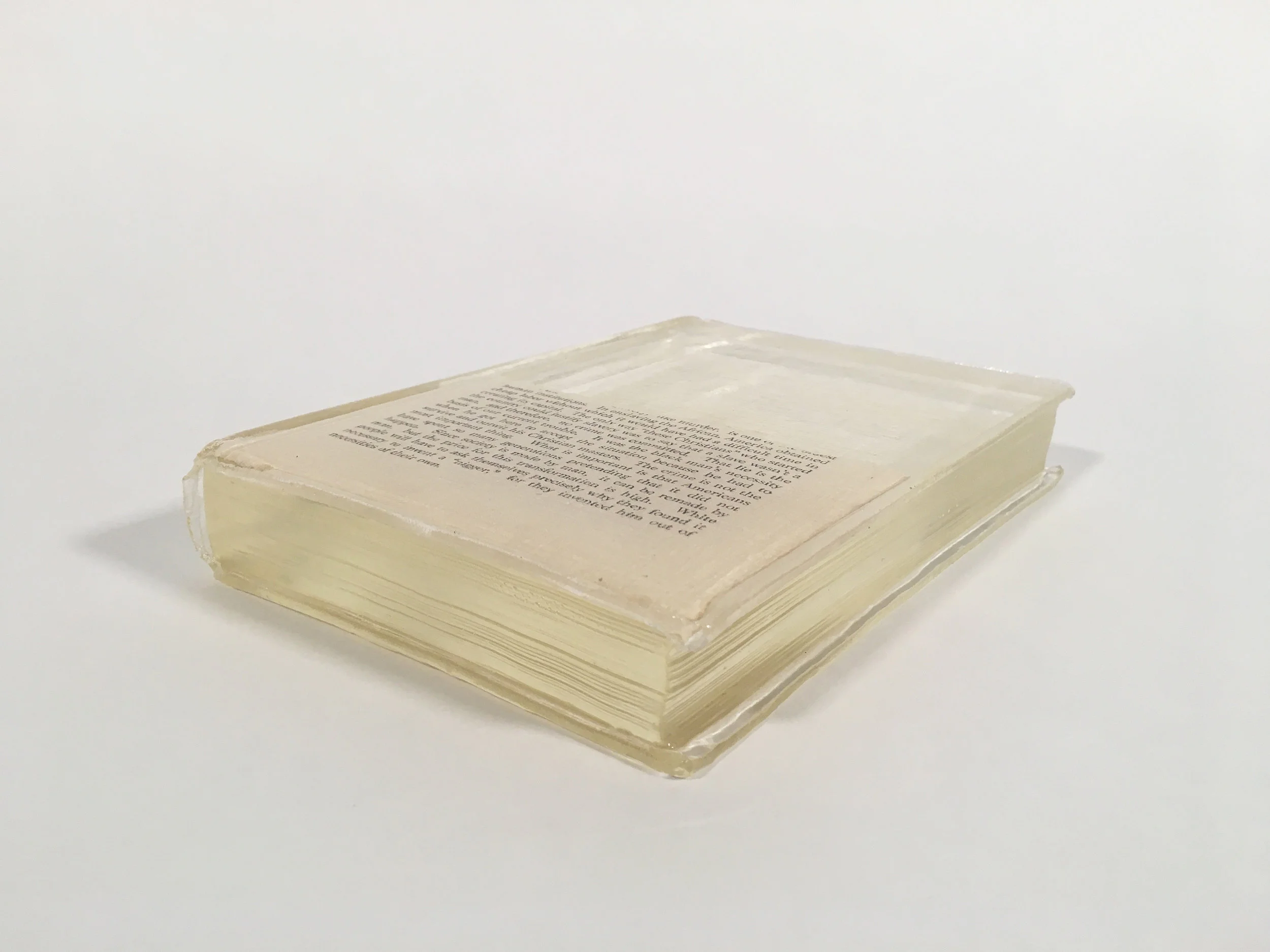
Living Monuments questions the production and dissemination of history. Through lesson plans for teachers and pro-Confederate books in classrooms and libraries, the United Daughter of the Confederacy reshaped history and taught children to be “living monuments”. Their influential work not only taught the tenets of the Lost Cause, but removed black Americans from the pages except through the understanding of slavery. Appropriating the Jim Crow-era school books, the works are transparent resin casts of the originals. The false histories of the books have been hidden, while the words and writings of James Baldwin have been memorialized by the casing of the book. The writer, artist, and civil rights activist James Baldwin, who spoke at length of the prevalence of white supremacy, the invention of race, and the abuse of history, has his words emerging from the ghosts of this education. Living Monuments uses the schoolbook as a battleground where education, history, and power are challenged by Baldwin.
On a hot New York Monday in 1955, Wilsonia Driver had missed her train stop. She was a recent alumna from Hunter College and had woken up that morning with excitement and pride. Ms. Driver had been offered a writing position at the New York Times, but when she arrived at the office on West 43rd St. the Times staff were not expecting a young black women. Despite her protests, Ms. Driver was quickly told that the position had been taken.
She left in a daze of anger, making her way to the train station. When Ms. Driver realized she had missed the 96th St. stop, she was already at 135th St. As she made her way across the street to catch the train back downtown, she saw a sign that read, Schomburg, as she recounts, “I was hot. I was mad, and I was everything. And I said to the guy who was standing outside, ‘What kind of library is this? I just got out of Hunter. I never saw this library.’”
When she learned that the Schomburg library’s collection was dedicated to books by and about black people, Ms. Driver responded with, “There must not be a lot of books in here.” The librarian sat her down at a long table with three books from the collection, Up from Slavery by Booker T. Washington, The Souls of Black Folk by W. E. B. Du Bois, and Their Eyes Were Watching God by Zora Neale Hurston. After reading a third of Their Eyes Were Watching God, Ms. Driver asked the librarian, “How could I have been an educated woman and not have read this?” and then began to cry. That young alumna would become the poet, playwright, activist and educator, Sonia Sanchez, who is best known as one of the architects of the Black Arts Movement.
A Letter for Sonia Sanchez is a collection of books built from a list of 50 literary works from black Americans, dating from 1773 to 1965. The works builds from Sanchez’s emotional story of frustration and discovery, while examining the access to these authors and books, then and now. The books in A Letter for Sonia Sanchez must be checked out from the local libraries while still providing the original list to the audience. The work uses the available library books and ratchet ties to create a monument of literature that is bound by the yellow industrial straps. The use of the ratchet ties as a book strap or belt, references the other work in the Look Away series, as part of the removal of monuments and the yellow as a cautious warning.
For much of the country’s life, it has taught a version of history that excluded black Americans. In the mid-1960s, the most popular textbook for eighth-grade U.S. history classes only mentioned two black Americans in the century since the Civil War. The suppression of black history and art is intertwined with the repression of black rights and equality. A Letter for Sonia Sanchez is an examination of the suppression and distortion of black history, culture, and education, while providing light to the depth and diversity of American literature.
“If you could choose one word to represent the centuries of bondage, the decades of terrorism, the long days of mass rape, the totality of white violence that birthed the black race in America, it would be ‘nigger’,” declares author Ta-Nehisi Coates. It is a word that has endured through centuries, in both white and black vernacular. It is a word that has justified, sustained, and celebrated white supremacy. “There is no better proof of its enduring toxicity than the fact that, in polite society, it is spoken and written only in its euphemistic shorthand — ‘the n-word’,” Dave Sheinin and Krissah Thompson write. For nearly as long, its use in black vocabulary has been an act of subversion and appropriation, and as Elizabeth Stordeur Pryor explains, “Consider the possibility that when African Americans spoke the word nigger to each other, they did so to articulate a sense of place within a land that was not their own.”
Our Word is the history of America through the divergent word, nigger. From British North America and Emancipation to hip-hop and political correctness, the work examines its contemporary forms as nigga within mainstream media and culture, and as “the N-word” euphemism within political speech.
Our Word is a sound piece utilizing both sides of the same vinyl record played on turntables at the same time. On one side of the record, the work looks at the creation of the euphemism and its ability to sanitize the discussion of race and history. On the other side of the record, the work examines the word throughout America’s history and the debate over its use within black vocabulary. The work builds the two histories together, interweaving the evolution of the slur with the crisis of the 1990s Los Angeles. It recounts the drama of the O.J. Simpson trial and the role of the word along with the complexity of the word in black vernacular following the Civil Rights Movement.
When the two sides of the record are played together, they create a dialogue through spoken word, piano, and drums, addressing the brutality of racism and the nation’s inability to confront it.
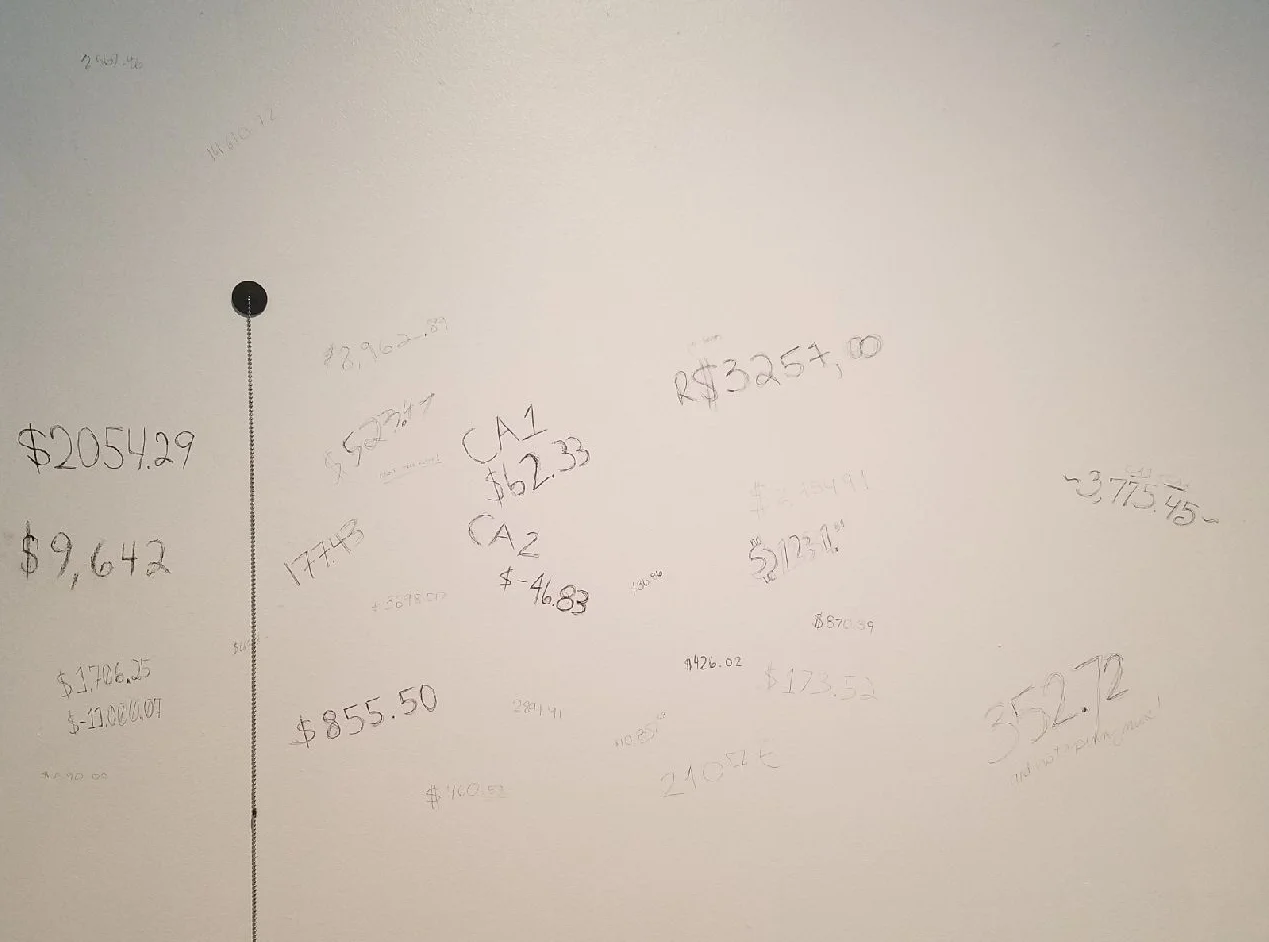
TaskRabbit, founded in Boston in 2008 as RunMyErrand, is an online marketplace that allows users to outsource everyday activities. The service can be seen as the fruition of the gig economy, where legions of independent contractors assist with even mundane tasks. Despite the freedom of scheduling and the promise of supplementing income, there are many people willing to take on such exploitive work because of a weak and volatile economy.
Throughout the night of the opening, “Taskers”, or “Rabbits”, were consecutively requested with a simple task to create the performance. Taskers are asked to write down the total amount within their checking account at that moment in the gallery. The remnants of the performance are a collection of lives and circumstances in the form of numbers.
Civil unrest had reached critical mass. It was the first night of the 2016 Chinese New Year, but a riot had broken out on the streets of Mong Kok. Bricks ripped from the pavement in addition to broken bottles, trash cans, shipping palettes, and even police barricades bombarded Hong Kong police officers. As the chaos erupted, a Hong Kong police officer pointed his pistol at the unyielding crowd of protesters in self-defense. The show of force and locked aim did nothing to subdue the approaching swarm or their projectiles. The officer quickly fired two shots in the air as another officer laid on the ground unconscious. By the end of night, 61 citizens had been arrested, scores injured, at least 22 fires had been set, and over 2,000 bricks had been dug up.
Since the start of the Umbrella Revolution in 2014, political tension between Hong Kong and China has been palpable. Pro-democracy forces remain resistant to Beijing as it pulls Hong Kong further under its political influence. Hong Kong, a semiautonomous city with an open press and freedom of speech, continues to be scrutinized by China since its handover from the British in 1997. Hong Kong has long been a global trading post, and even with the rise of a capitalist China the city remains Asia’s financial center. Hong Kong has a unique position as a bridge between the mainland and global economy, providing a transparent justice system with secure investment conditions.
As citizens remain defiant, the Hong Kong government has banned protests during visits from top Chinese officials and continues to glue bricks down to the pavement throughout the city to prevent a repeat of the 2016 riots. The pro-Beijing government demonstrates its authority and commitment to China by gluing the bricks into place; uprooting the bricks, contests sovereignty, place, locality, and the forfeiture of culture.
A suppressed subject under British and Chinese rule, Hong Kong’s independence has become a mainstream conversation as more people consider themselves Hongkongers rather than Chinese. Growing fears of the loss of identity and culture are embedded in their democratic values and judicial transparency that protects freedom of speech and assembly.
In Equivalent, the struggle for Hong Kong’s political, social, and economic freedom has come down to control of the ground beneath their feet.
Within Hong Kong and China there are a few ways of providing bribes, known as tea money or in Cantonese, chaqian茶錢. In China, tea money is widespread, where it is needed for almost every transaction and service. In recent Hong Kong history, tea money was required at public hospitals or even to have a residential telephone line installed. Tea money is usually provided as a monetary gift within red envelopes, used at times of celebration such as Chinese New Year or weddings, or lining a box of moon cakes, a local delicacy.
The Hong Kong dollar notes, with the exception of the 10 dollar note, are all printed by three commercial banks instead of a central bank such as the Federal Reserve Bank in the United States. Under license from the Hong Kong Monetary Authority (HKMA), the Bank of China, Hongkong and Shanghai Bank or HSBC, and Standard Chartered Bank issue their own bank notes for circulation. All three banks have been involved in money laundering, or indicted and/or settled laundering charges out of court. HSBC was a source for funding the opium trade in China during the 19th century and has continued in this line with the recent revelation that the bank was laundering billions of dollars for Mexican drug cartels.
Tea Money uses appropriated red envelopes that read fortune (福) to deliver the artwork, three moon cake designs that incorporate the logos of the banks. The prints are made from a custom chop, a traditional stamp or seal, which in China and its territories is seen as providing authority and authentication. The work utilizes many cultural aspects that symbolize luck and good fortune while also discussing the corruption and the flaws in the Chinese and Hong Kong capitalist economy.
In Hans Haacke’s 1982 installation, Ölgemälde, Hommage à Marcel Broodthaer, a painted portrait of US President Ronald Reagan faces a blown-up black-and-white photograph of an antinuclear protest. The two images are connected by a red carpet, while stanchions and a velvet rope protect the portrait. The rawness of the protest photograph is furthered by the inclusion of the black boarder, sprocket holes, and frame numbers. The installation contrasts not only the imagery, but the mediums and styles of the two opposing visuals. History and power is examined in the work by different technologies and methods of capturing visual information and context.
The painting of US President Barak Obama in #Ölgemälde commands the same authority that Haacke’s Reagan painting does, utilizing the history of oil painting, as well as the gold frame, stanchions, and velvet rope ornaments. For #Ölgemälde, the blown-up black-and-white photograph is replaced by the current everyday tool of visual communication, a smart phone. The grandeur of the oil painting is juxtaposed with a repeated loop of raw videos from social media capturing abuses of police privilege; actions that led to the preventable deaths of black Americans. Once again, the installation highlights the imbalance of power and authority while going deeper to examine a paradoxical system embedded with racism in the time of the United States’ first black President.
It is referred to simply as the Wall, but it has been given many names, the West Bank Barrier, Separation Barrier, Segregation Wall, and the Apartheid Wall. When it is completed, the Wall will be a 440-mile barrier that divides Israel from the occupied West Bank. Despite the arguments for or against it, the Wall is a looming symbol for the relationship and negotiations between the Israelis and Palestinians. The Wall is a “monument to failure and a testament to pessimism,” as one artist has described it, “The segregation and confinement of people is only another step towards alienating Palestinians and Israelis from one another and dehumanizing the conflict. When one ceases to view the other side as made out of individuals with hopes and dreams, violence becomes much easier and the results are tragic for both sides.”
False Wall utilizes drawing as its primary medium, with the original work being 30" x 22". The drawing was then scanned and printed to 228” x 108”. The scale and presentation of the work is to emphasis the fragility and ephemeral nature of lines and borders. While the use of the triptych is to highlight the paradox of the barrier wall and the struggle in the world’s Holy Land.
In the aftermath of the September 11th, 2001 attacks, the United States Central Intelligence Agency (CIA) established a secret detention program, where suspected terrorists were apprehended, detained, and interrogated. The extrajudicial and highly classified program included “extraordinary rendition” in which suspects were kidnapped and transferred to secret prisons. Detainees were exposed to “enhanced interrogation techniques”, which were based on torture, abuse, and humiliation. These clandestine prisons came to be known as “black sites”.
Thirtyfour Black Sites is based on Ed Ruscha’s Thirtyfour Parking Lots in Los Angeles (1967). Ruscha’s work documented the growing and changing infrastructure of a sprawling American city without a center. The aerial photographs of vast empty parking lots describe a system and pattern of daily culture and habit. Similarly, Thirtyfour Black Sites reveals a vast infrastructure, but of a secret detention program with a chain of prisons owned, operated, and/or utilized by the CIA. The images make the abuses and locations less abstract while also analyzing the growth of secrecy, extrajudicial black programs, and the CIA as a covert paramilitary.
Coup (pronounced koo), or Cloth of Unified People, is a clothing brand that brings together art and activism with fashion and apparel. The apparel is meant as public art to help discuss and/or critique history, education, violence, economics, and rights, among other issues.
Purchase apparel at ETSY
Since the end of 2001, it is almost daily that we hear news reports of bombs being dropped, missiles being fired, and areas being targeted by the United States military. With the numbers of missiles so high and so frequent it is difficult for anyone to comprehend their impact, both financially and in scale. The size and presence alone of these missiles is daunting and intimidating, with some missiles as tall as 15 feet (4.5m). The price is just as overwhelming, with some missiles, like the Tomahawk, costing over $1.5 million each.
Details assists in making these dimensions and costs real.
AGM-65 Maverick – 8’ 2” – $110,000 each
AGM-84E SLAM – 14’ 8” – $720,000 each
AGM-88E HARM – 13’ – $870,000 each
AGM-114 Hellfire – 5’ 4” – $110,000 each
AIM-9 Sidewinder – 9’ 11” – $665,000 each
GBU-12 Paveway II – 10’ 11” – $21,000 each
“That was when I came close to insanity,” Binyam Mohamed said, describing his detention at Guantanamo Bay:
There were loudspeakers in the cell, pumping out what felt like about 160 watts, a deafening volume, non-stop, 24 hours a day. They played the same CD for a month, The Eminem Show. It’s got about 20 songs on it and when it was finished it went back to the beginning and started again.
In 2003, the US Department of Defense (DoD) and Central Intelligence Agency (CIA) began approving and using music as an “interrogation” tactic within the broadly defined War on Terror. The practice of acoustic bombardment, dubbed music torture by critics, is where music (in this case, artists like Metallica, Christina Aguilera, Eminem, Queen, and Bruce Springsteen among others, along with the Sesame Street and Barney theme songs) is repeatedly played at deafening and maddening levels and lengths. The technique became common practice as psychological torture in prisons and detention centers in Afghanistan and Iraq, as well as the naval base in Guantanamo Bay, Cuba and secret (or black) prisons such as the one used in Rabat, Morocco. In a declassified CIA report, Counterterrorism Detention and Interrogation Activities, specifics of the technique are laid out for soldiers and agents:
As a practical guide, there is no permanent hearing risk for continuous, 24-hours- a-day exposures to sound at 82 dB or lower; at 84 dB for up to 18 hours a day; 90 dB for up to 8 hours, 95 dB for 4 hours, and 100 dB for 2 hours.
This passage from the report is one of the few pertaining to the use of music and white noise that has not been redacted. Along with this report and others released through Freedom of Information Act requests as well as interviews and first-hand experience from former detainees and soldiers, there is a picture that is painted of detainees being shackled in stress positions within dark rooms that were extremely cold or hot while being forced to listen to deafening music for hours and days. Ruhal Ahmed, a former Guantanamo Bay detainee, described his experience in a 2009 interview, “It makes you feel like you are going mad. You lose the plot, and it's very scary to think that you might go crazy because of all the music, because of the loud noise, [ . . . ] So after awhile it just plays with your mind.” Though music has been used before in war and psychological operations, the recent development in the method is much more scientific to quickly remove a prisoner’s identity, making them more malleable, and to “maximize his feeling of vulnerability and helplessness.”
The audio component captures, within seconds, the disorientating psychological effect that the detainees experienced during the music. It is a selection of the music used during the torture, where the songs are overlaid upon each other while being played at the same time, as an orchestra of confusion and psychosis. The corresponding visual work is the sheet music for each song used, but also layered upon each other until the musical notation redact and remove any readable information completely.
In an appeal to save Iraqi’s academics, the BRussells Tribunal, a group made up of activists, intellectuals, and artists who organized a series of hearings by the same name, wrote: A little known aspect of the tragedy engulfing Iraq is the systematic liquidation of the country's academics. Even according to conservative estimates, over 250 educators have been assassinated, and many hundreds more have disappeared. With thousands fleeing the country in fear for their lives, not only is Iraq undergoing a major brain drain, the secular middle class - which has refused to be co-opted by the US occupation - is being decimated, with far-reaching consequences for the future of Iraq. The wave of assassinations appears non-partisan and non-sectarian, targeting women as well as men, and is countrywide. It is indiscriminate of expertise: professors of geography, history and Arabic literature as well as science are among the dead. According to the United Nations University, some 84 per cent of Iraq's institutions of higher education have already been burnt, looted or destroyed. Iraq's educational system used to be among the best in the region; one of the country's most important assets was its well-educated people. This situation is a mirror of the occupation as a whole: a catastrophe of staggering proportions unfolding in a climate of criminal disregard. As an occupying power, and under international humanitarian law, final responsibility for protecting Iraqi citizens, including academics, lies with the United States. Though the death toll is not known, the BRussells Tribunal maintains a list of recorded killings of academics and administrators. List is currently at 471. (August 2012)
Wipe the Slate is a temporary memorial dedicated to the academics and professors who have been murdered or disappeared in post-2003 Iraq. The work is the writing and subsequent erasing of the 471 names and lives on separate chalkboards that mirror protective blast walls.
In October 1994, Morton Halperin, the special assistant to President Clinton and senior director for democracy at the National Security Council, said, “We divide the world in two, those countries who choose democracy, we help . . . in those who do not choose it, we create conditions where they will choose it.”
The use of power and force has often been legitimized as a humanitarian need. This power is more than often used militarily, which is labeled as a force for good, with the set goal of delivering democracy and freedom. Yet, what is often delivered is economic and market policies that are hardly in favor of the people that are suffering.
This power does not need to be always through military, dominance can be exerted through economic means, such as aid. The United States International Development Agency (USAID) was developed to provide foreign relief and development assistance in accordance with US policy objectives, stating, “U.S. foreign assistance has always had the twofold purpose of furthering America's foreign policy interests in expanding democracy and free markets while improving the lives of the citizens of the developing world.” Sasha Kramer, a professor of International Studies at University of Miami, questions the twofold purpose:
This dual mandate raises the important question of whether US policy interests generally result in improved living conditions for the majority of the world's poor? While it may occasionally be the case that the interests of the US government and the poverty stricken citizens around the world are aligned, more often than not, US economic and political interests are dependent on the exploitation and manipulation of workers and consumers in the developing world. It is this inherent contradiction within the USAID mandate that should cause skepticism among US taxpayers concerned with issues of social justice and self determination. The fundamental problem with USAID's stated objectives is that it is not in the national interests of the US government to promote self sufficiency in developing countries. US economic interests are fed by foreign dependency on US imports and loans. Political interests are served by maintaining an economic stranglehold on foreign governments, and many a strategic alliance has been forged out of economic necessity. Among USAID's operating tenets are sustainability and local capacity building, noble goals but highly dependent on how these tenets are defined and the manner in which they are implemented. Sustainability of what, and which local capacities are being supported? Implementation is primarily shaped by another of USAID's governing tenets, selectivity, the allocation of resources based on foreign policy interests.
In 2011, a study was released entitled, A Crisis of Trust and Cultural Incompatibility, which dealt with the Afghan National Security Force (ANSF) murders of US and NATO forces. Common complaints by Afghans about the American soldiers were their cultural insensitivity and arrogance. These complaints manifested themselves in another common but more specific complaint, public urination by US troops. The report goes on to state that soldiers commonly urinate in front of women, exposing themselves.
After 11 years of war, Afghanistan is not any closer to being a stable country with an independent government. The key to any counterinsurgency strategy, as Lyndon B. Johnson stated in 1965 about Vietnam and has been echoed again and again, “The ultimate victory will depend upon the hearts and minds of the people who actually live out there.” Afghanistan has been called the “Graveyard of Empires,” and has a long history of resistance to occupation.
During the French occupation of Spain in the 19th century, the Spanish could not defeat the French militarily and were pushed back and punished each time. The Spaniards resistance came from locals without training who fought when possible and would disappeared in the villages. The fighters have come to be known as guerilleros and their warfare as guerrilla, or small war. Napoleon would later write, “That unfortunate war destroyed me.” The successful resistance to French military occupation was described as “the fabled lion who was tortured to death by a flea.”
At the height of their use during the War on Terror, there were least 50 unmanned aerial vehicles (UAVs), or drones, hovering over Libya, Yemen, Iraq, Afghanistan, and Pakistan. Drones are remotely operated aircrafts used for intelligence, surveillance, and reconnaissance (ISR), as well as attack missions. Though the plane and ground crew remain in strategic locations throughout the Middle East and South Asia, the pilots that operate the drones are located over 7,500 miles away linked by a satellite connection.
YouTube War is a series of drone videos, collected from YouTube and other online video sources, overlaid with the soundtrack of the video game, Call of Duty: Black Ops. The videos are posted as war porn by soldiers and meant to excite the viewer at the climax of destruction and death. The videos also display the lack of clarity and understanding of the circumstances, and offer war as a video game; completely disconnected from the violence and the victims.
During the wars and Afghanistan and Iraq, thousands men of fighting age (15-50) were detained through house raids by US and Coalition forces. The raids were often based on bad intelligence, which led to the terrorizing of families and the extended detention of the men without charge. The physical and mental treatment of the detainees and the emotional trauma to the women and children has dramatically scared families. Though international military forces may leave Iraq and Afghanistan, the violence and trauma of war remains. Fallout focuses on the devastation that a culture of violence and war has on its people and their families.
By using and manipulating found photographs from the destroyed Saddam International Tower in Baghdad, Iraq, Fallout makes evident real families that will remain damaged or destroyed by brutality, detention, and terror.
Throughout the past century, democracy has been used as a means to export an economic system that opens and deregulates markets, privatizes capital, and socializes debt. The focus of these policies are not countries that lack transparency, rights, and social equality and representation, but those who have not accepted the American economic system. Free Market Democracy is a collection of business promotional props that have all been produced in countries where regulations and rights have been heavily reduced in pursuit of free markets and not democracy and freedom.
“Buried in Iraq's clay and dirt is the history of Western civilization. Great empires once thrived here, cultures that produced the world's first wheel, first cities, first agriculture, first code of law, first base-sixty number system, and very possibly the first writing. A brutal plundering of this rich cultural heritage has been taking place in broad daylight ever since the 2003 invasion of Iraq,” reported journalist Diane Tucker. Since the invasion of Iraq, ancient cities have been turned into strips of land for military bases. Priceless artifacts have been sold on eBay for a hundred dollars. The National Museum of Iraq was looted, losing thousands of artifacts, while US soldiers protected the Ministry of Oil. Shock and Awe, tells of this destruction through the very act of vandalization.
In March 2010, it was discovered that the rifle sighting scopes used by US forces in Iraq and Afghanistan were inscribed with references to New Testament passages that spoke of Jesus Christ and Christianity as the light of the world. U.S. Military rules specifically prohibit the proselytizing of any religion in Iraq or Afghanistan and were drawn up in order to prevent criticism that the U.S. was embarked on a religious ‘Crusade’ in its war against al Qaeda and Iraqi insurgents. Kingdoms Rise And Wane discusses the clash of ideologies that still remain, but began with the American Century and President Woodrow Wilson’s claim that the world must be Christianized and made safe for democracy.
“Independent, aggressive and critical media are essential to an informed democracy. But mainstream media are increasingly cozy with the economic and political powers they should be watchdogging. Mergers in the news industry have accelerated, further limiting the spectrum of viewpoints that have access to mass media. With U.S. media outlets overwhelmingly owned by for-profit conglomerates and supported by corporate advertisers, independent journalism is compromised,” states the national media watch group Fairness and Accuracy in Reporting. Cause-Effect highlights these corruptions within the news media system while also emphasizing the context and the lack of history in which the news is received.
Primer deals with the permanent damage on children who lose their childhood to prolonged wars, often drawing the violence that they witness and experience. The work is a set of crayons molded into 50 caliber bullets.
June 11th, 2009
National Portrait Gallery
8th St NW
Washington DC 20001
Dear National Portrait Gallery,
I am writing you in hope that I may submit a portrait painting (oil on panel) to the National Portrait Gallery. As you are aware of, the NPG recently unveiled the official portrait of the 43rd President George W. Bush on December 19th, 2008. Accompanied with the painting was the caption, “[His two terms were] marked by a series of catastrophic events [including] the attacks on September 11th, 2001, that led to wars in Afghanistan and Iraq.” Following the unveiling, Senator Bernard Sanders of Vermont wrote to the NPG with the suggestion of correcting the text to remove the “collaborative relationship” between Iraq and September 11th attacks, citing a quote from President G. W. Bush in September 2003, “We’ve had no evidence that Saddam Hussein was involved with September the 11th.” The Gallery Director, Martin Sullivan, thought the request was reasonable and agreed to remove the words “led to” from the caption. Mr. Sullivan responded later by saying, “We have got to get our history right [. . .] I don't like the rewriting of history."
The Smithsonian's National Portrait Gallery was established to visually “tell the stories of America through the individuals who have shaped U.S. culture,” to “link us to our past, our present, and our future”, including “poets and presidents, visionaries and villains”.
With these two statements in mind, I would like to submit a portrait painting of an Iraqi resistance fighter. I agree completely with the Gallery’s Director, Martin Sullivan, that it is essential to understand our history and not to rewrite it to fit to our own viewpoint. I believe that this painting, created in response to the events discussed above, will help to further that understanding. The portrait was created, not to glorify violence in Iraq, but to remind Americans of just one of the many disastrous and destructive results of the Iraq War. Understanding that the attacks on September the 11th did not “led to” the Iraq War, but the Iraq War led to the destruction of a country, a people, and a culture, and to the creation of many new enemies.
I would like to offer the donation of this painting to the NPG free of charge. My only request is that the painting be presented with a caption that includes its purpose. Being the artist, I have full ownership of the work. I have included images of the painting along with this letter for your consideration. I would like to thank you for your time and thought. I look forward to your response.
Sincerely,
Chris Revelle
Insurgent reframes American history with contemporary language. The work reexamines one of our founders, George Washington, and the nation's history of resistance to occupation and unfair rule of law.
The White House East Room, April 14th 2008
The President Commemorates the 265th Birthday of Thomas Jefferson
We're here tonight to commemorate the 265th birthday of Thomas Jefferson, here in a room where he once walked and in a home where he once lived. In this house, President Jefferson spread the word that liberty was the right of every individual. In this house, Jefferson sent Lewis and Clark off on the mission that helped make America a continental nation.
With a single sentence, Thomas Jefferson changed the history of the world. After countless centuries when the powerful and the privileged governed as they pleased, Jefferson proclaimed as a self-evident truth that liberty was a right given to all people by an Almighty.
Here in America, that truth was not fully realized in Jefferson's own lifetime. As he observed the condition of slaves in America, Jefferson said, "I tremble for my country when I reflect that God is just" and "that his justice cannot sleep forever." Less than 40 years after his death, justice was awakened in America and a new era of freedom dawned.
Today, on the banks of the Tidal Basin, a statue of Thomas Jefferson stands in a rotunda that is a memorial to both the man and the ideas that built this nation. There, on any day of the week, you will find men and women of all creeds, colors, races and religions. You will find scholars, schoolchildren and visitors from every part of our country. And you will find each of them looking upward in quiet reflection on the liturgy of freedom -- the words of Thomas Jefferson inscribed on the memorial's walls.
The power of Jefferson's words do not stop at water's edge. They beckon the friends of liberty on even the most distant shores. They're a source of inspiration for people in young democracies like Afghanistan and Lebanon and Iraq. And they are a source of hope for people in nations like Belarus and Burma, Cuba, Venezuela, Iran, Syria, North Korea and Zimbabwe, where the struggle for freedom continues.
Thomas Jefferson left us on July 4, 1826 -- fifty years to the day after our Declaration of Independence was adopted. In one of the great harmonies of history, his friend and rival John Adams died on the very same day. Adams' last words were, "Thomas Jefferson survives." And he still does today. And he will live on forever, because the desire to live in freedom is the eternal hope of mankind.
The installation and performance entitled The Spread of Democracy, was a faux Armed Forces Career Center or recruitment center that appeared to be the guest of the California Institute of the Arts. The recruitment office displayed and offered posters, flags, video games, maps, brochures and publications that appeared to be legitimate. Though the posters and brochures were created to appear authentic, the works dealt with many complex issues of American militarism such as U.S. bases throughout the world, propaganda, the economy of militarism, current programs like rendition and privatization, and their history. During the week of the exhibition I also played the part of a US Army Sergeant in full fatigues, adding to the illusion. The objective of the exhibition was twofold, to discuss the complexity and vastness of the Department of Defense and US militarism, and to motivate the liberal but apolitical student body to take action against what could only appear as the first military occupation of the school.
In an effort to represent the true “Social Responsibility” of Starbucks, I altered two Starbucks advertisements in the work I am Starbucks. In 2005, Starbucks opened a location in Guantanamo Bay, Cuba, 3 years after the U.S. Naval Base was transformed into a detention center. Since 2005, Starbucks has opened two more locations on the base. The art replaced the images and stories within the original advertisements, which stated, “I am Starbucks”, with images and stories of Guantanamo Bay detainees. The adjusted advertisements were then placed back into Starbucks within the Santa Clarita, CA area.
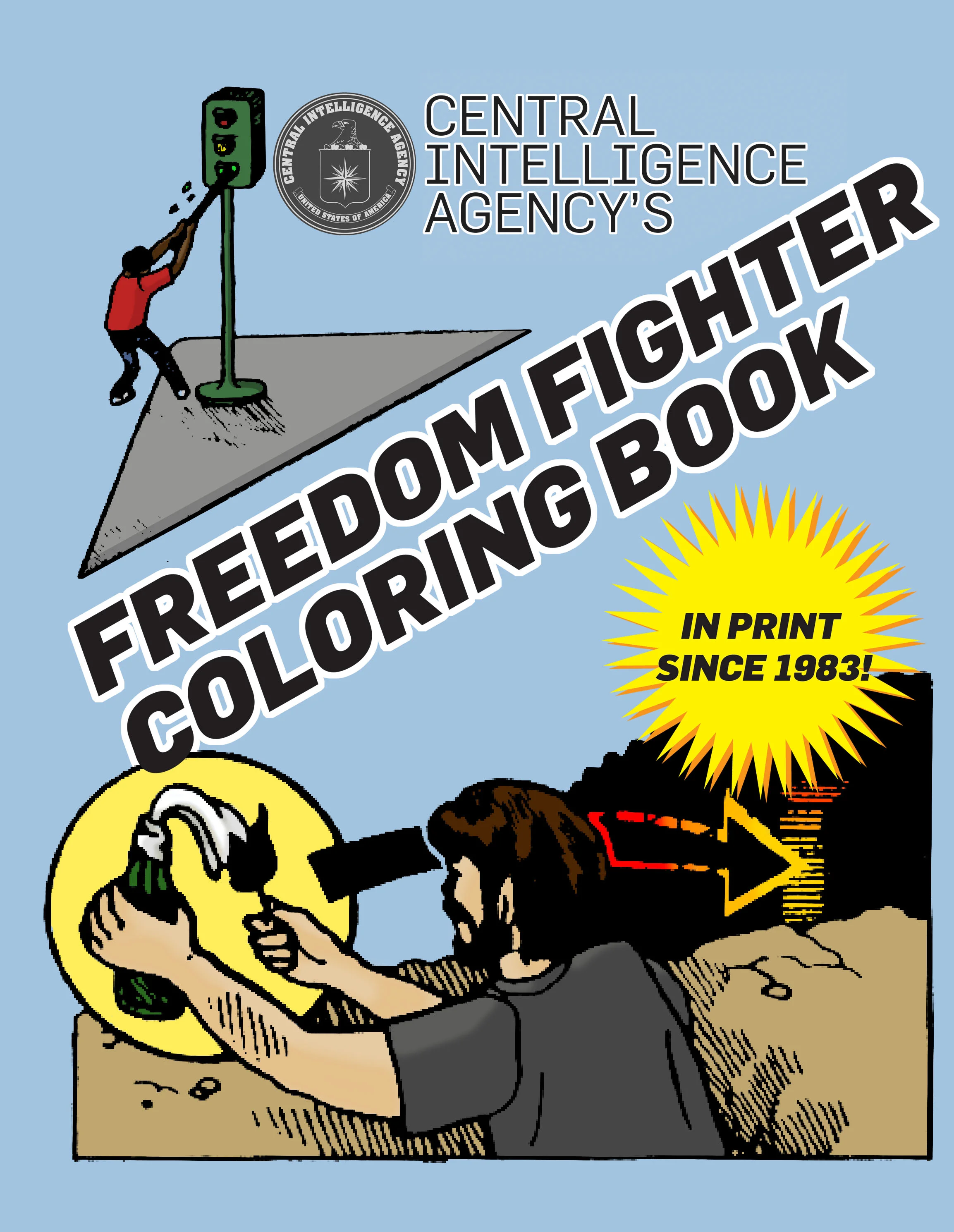
Published by the United States Central Intelligence Agency (CIA) in 1983, the Freedom Fighter's Manual was first provided to the anti-Sandinista Contra forces, as well as other Nicaraguans opposed to the Sandinista National Liberation Front (FSLN).
In 1979, the Sandinista National Liberation Front overthrew the U.S. supported dictator Anastasio Somoza and established a socialist government that developed diplomatic relations with the Soviet Union and Cuba. When they began to fund a similar revolutionary group in El Salvador, the Reagan administration felt that Nicaragua was becoming a threat to its national interests and began to fund the contras, in order to destabilize the government. However, it was important to show the world that a government based on socialist principles would not function, in the hope of discouraging other popular revolts from occurring. The United States of America assisted in training, arming, equipping, financing and supplying the Contra forces and encouraged, supported and aided military and paramilitary activities in Nicaragua. To assist in the process of fighting socialism in Nicaragua, the CIA published and airdropped the Freedom Fighter's Manual.
In February of 2007, the United Nation Intergovernmental Panel on Climate Change released its Forth Assessment Report. The report stated that the warming of the climate system is indisputable and is dependent on carbon fuel intensity of human activities. The IPCC scientists reported that the climate change was not a natural cycle of the planet and that hotter temperatures and sea level rising “would continue for centuries.” The results of human activities would be an increase in heat waves, rainfall, drought, hurricanes, and high tides. The geoscientists at Princeton and Columbia have both acknowledged the danger of glacier melting and rising sea levels. They have estimated that if Greenland or the West Antarctic ice sheets melt, sea levels could rise by 20 feet (6 m).
A series of map were created to show these devastating effects of future climate change and its result on sea levels. The maps display the changing coastlines of continents, countries and islands that will be affected by the estimated 6-meter rise in the world oceans.